

State & Local: Representative Stephen Ross
Q2 2026 | Vol. 76, Issue 2
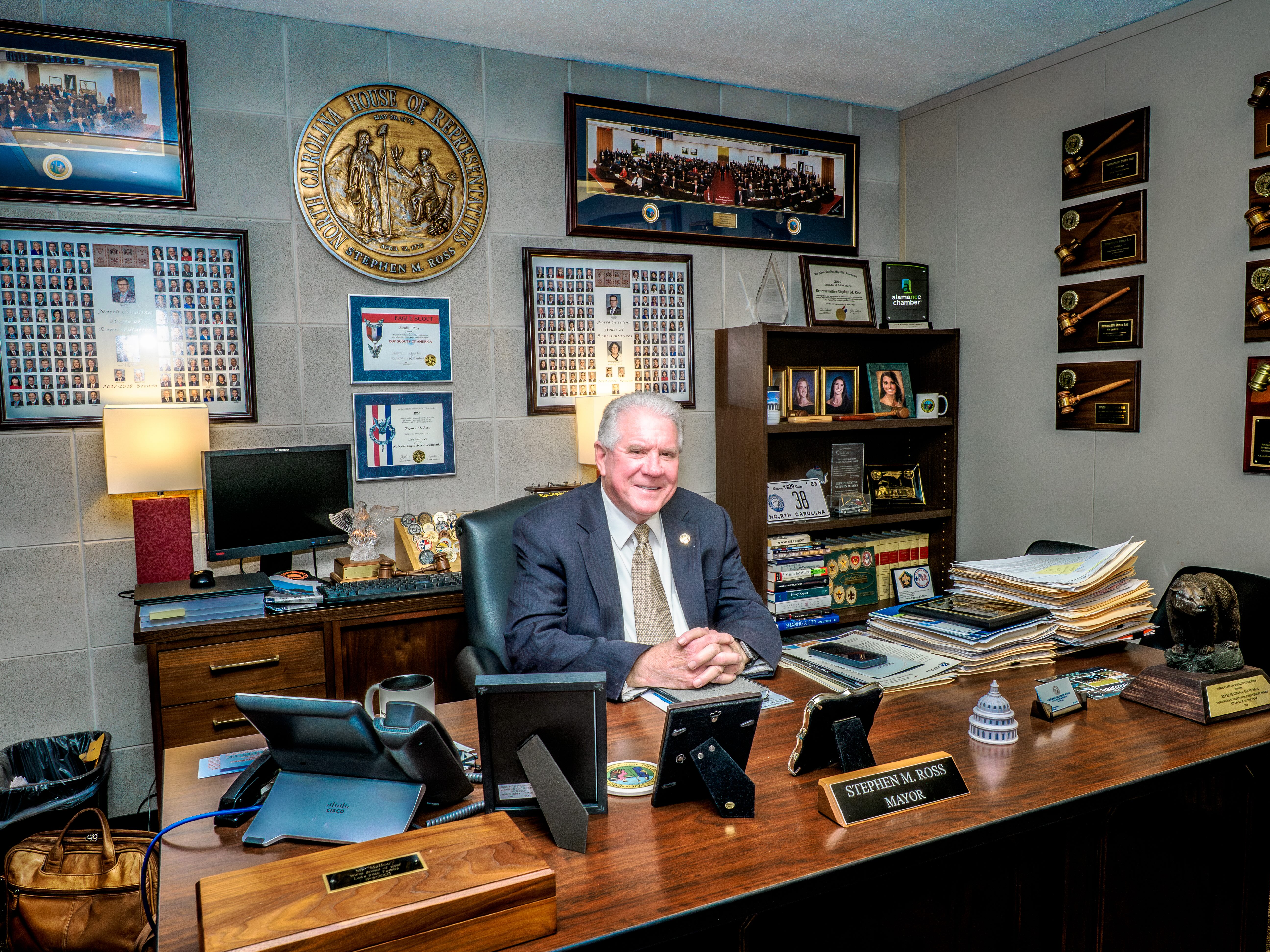
Rep. Stephen Ross will retire from the N.C. General Assembly at the end of this year with six terms, or 12 years, of state legislative service to look back on—and then some. Before he entered the State House, Rep. Ross was Mayor Ross, and Council member Ross prior to that, in his home of Burlington. This proud background has deeply shaped his approach as his district’s legislator and his appreciation for how the state and its local governments can work together for intentional, cooperative, and lasting change, along with preservation of great fundamentals. It makes for no surprise that the League and Rep. Ross have a history of great progress together that included efforts early in his legislative career, like his work on the state’s important tax credit for rehabilitation of historic structures, and his leadership with a lawmaker caucus of fellow former municipal officials. In February, Southern City met with Rep. Ross in his legislative office (where he works alongside his wife, Tammy Ross, who helps coordinate his schedule and communications) for a look back on his public service and what he’s gathered from the intergovernmental dynamic.
BROWN: You have six legislative terms to look back on with prior service at the municipal level as mayor. What comes to mind most with this right now?
ROSS: I think for me, what stands out is the atmosphere that I came into. In 2012, there was a lot of energy around tax policy, around regulatory reform, and trying to fix different things, because unemployment when I first came in was double-digit. Taxes were really high. We met in committees and groups and with leadership, and started looking for opportunities to really fix problems. And it was a lot of work back then. It was very active. When I came in, Thom Tillis was the (State House) speaker, and I went to Thom, and I said, “I'm brand new. What do I do?” He said, well, your background is in finance, so I want you to go over to the Finance Committee and help them figure out how to fix workers’ comp. And so that was the very first meeting that I attended. (State Rep.) Julia Howard was the chair. And I remember getting into the meeting, and I was going through the numbers and recognizing some of the areas that needed to be fixed. And after the meeting, I went to Julia, and I said, this is what I see here. She looked at me, and she said, I can't believe how fast you've really picked this up. She said, you're one of the only ones in here that actually get this, which was a big compliment to me. I really looked at her as a sort of finance guru. And so, I've been kind of involved in finance ever since. But the thing I think that stands out to me most is recognizing that there are certain pieces of tax policy that benefit communities much more than just slashing taxes and hoping for the best, and the first example of that was when I went to work on the historic preservation tax credits. I had already been familiar with preservation prior to coming to the legislature, because we were trying to preserve buildings in my community. We were trying to renovate, rehabilitate, and because Burlington was a textile capital of the world. (After the industry went overseas) We had empty textile mills all over the place, and it looked like East Berlin after World War II. And so, I committed to trying to find a solution to that, and work very hard on that, and it took years to really get it fine-tuned. The Senate fought me all the way. But, fortunately, I had leadership, like Speaker Tillis, backing me. And then when (former State House) Speaker (Tim) Moore came in, he really saw the value in what we were trying to do, and he stepped up and really, really backed what we were doing. And then the rest is history. We got it passed. We have preserved just tons and tons of structures all across North Carolina, old mills and things like that that were dilapidated, and some of them even falling in. I was thinking earlier today, when I leave here and I look back and all those years, whether it was local government or state government, it's like, what did I do? Because at some point it becomes a blur, and then it just dawned on me that every time I ride around the state, and I see an old building that has been renovated, or an old mill that's been renovated, I can look at that and say to myself, I had a part in that, and so I can rest in knowing that I did have some impact. And it's just been a long journey, and I thoroughly enjoyed it. It's been the honor of my life. I don't like to think that I'm through with public service, right? I just don't know what I'll do next. Probably not public, probably not an elective office. Something else.
BROWN: The historic preservation tax credit was a great product of local and state leaders working together.
ROSS: It’s a great intersection of something productive that to me—and this has always been my feeling, even back when I was a mayor—that the state and the local communities are a partnership. To some degree, they're working together. The ultimate goal is to build better communities. And I think sometimes people forget about that. When I got here, I looked around and realized there just were hardly any members that had municipal experience. Just a few. And we had members that were trying to make decisions that involve cities that had no idea how a city government operates. I was very fortunate in that I came from a city that has always, and this is just my opinion, but I think Burlington has always been one of the best-run cities in North Carolina and a shining example of the way that a city should run. Let me tell you, they're doing it right…. I think there should be dialogue between any (General Assembly) member and their local municipality, their local government, fairly consistently. You'd be surprised the number of times in a committee – and I'll use de-annexation as an example – we're constantly having these members pop up and say, you know, I want to de-annex this section of the city. What does the city say about that? “Well, I haven't talked to them.” That's backwards, right? Totally backwards. That's not the way it's supposed to work…. One of the things I'd like to see as I leave here is some parameters put around those kinds of things, because it just got out of hand.
BROWN: What styles of communication do you prefer with your communities back home?
ROSS: I spend a lot of time with my local governments. I make appointments, I go in, I sit down with them, and we talk about their community. Because even in my county, I've got communities that are very different. I've got Burlington, which is sort of a rock of the county. And then I've got Graham. And then you got Mebane. They're all different. So you have to sit down and talk with them and understand where each one's coming from. I like to say you have to be involved in a community, even come from a community, to understand the heartbeat of that community. And I've always prided myself in always being a part of that community and having the opportunity to sit down and have a discussion with my local leaders, and it's been a great two-way communication. They know they call me all the time, and when I have a question about something, I'll call them. So, it's a good two-way street.
BROWN: What happens when local leaders aren’t in touch with their legislators? Where can good state-local relationships lead?
ROSS: A lot of times, there's a bill that comes forward (affecting local government), and municipalities don't even know about it. They find out about the night before. And again, that's just not the way it works. I've spent a lot of time working in economic development. That's been another area. When I first became mayor, we were at a ghost town ... We're going to reinvent where we're going, because textiles are not coming back. And we can sit here and we die the dust, or we can reinvent ourselves. And I said what we're going to do is restore the pride in Burlington ... and I would like to say we were successful in doing that. We started putting money into the areas in our infrastructure that would attract growth. ... The engine plant in Burlington. That was maybe our first big one. And then from that, it just kept going. Because by that point in time, I told the council, you make the investment in the infrastructure. I'm not talking about doling out money, but money in the infrastructure and having things where they're appealing. I said it’ll happen. And it did. And so, then they ask where can we put some more money? The city came to me about two years ago and said, we have a corridor down Highway 61 – if we could just get water and sewer down that corridor. We think it's right for development. So I got them a grant, a fairly sizable grant, to run water down Highway 61, and we just participated in the largest groundbreaking announcement in the history of Burlington, the biggest economic development deal in the history of Burlington. And I was telling somebody after that, I can remember when we first put the infrastructure in the ground and landed Honda Jet, and here we are…. I keep telling my colleagues here that we have got to fund infrastructure, because we have places in North Carolina that everybody talks about developing, but there's no infrastructure. ... When a company or corporation looks at making a decision to locate, they don't want to wait five, six, seven years for you to put all this stuff in the ground for them. They’re ready to go, right? And that's how we wound up with Honda. In the beginning, we had everything on their checklist, everything all the way down to FAA clearance to access the runway. And in that final meeting with Honda, we went down a checklist, and we got to that last one, and they looked up, and they said, this one’s difficult: we need FAA clearance to access the runway. And we said, "You got it.” They looked at us, and they said, what do you mean? We said we already have it, that FAA clearance. So that's forward thinking, pre-planning and that's what you have to do in establishing that sort of renewed sense of possibility.
BROWN: What led you to run for House?
ROSS: I was perfectly happy on the municipal level. I was really enjoying what we were doing. We were growing, we were building. Every time I turned around, there was another idea. And so, we were doing well. And then I met (then) Speaker Tillis at a luncheon and had a good conversation with him. He wanted to know, what are you guys doing in Burlington? He keeps hearing about Burlington. I just said, “We started looking outside the box. We started thinking bigger.” We started partnering with Greensboro. We grew into Guilford County. We ran a major water line to Greensboro to interconnect. We share law enforcement communication systems. We’d just done a lot of stuff more on a regional basis. I didn't think any more about it. (After the talk with Tillis) I went home, and three or four weeks later, he called me on the phone and said I'd like you to consider coming to Raleigh. I put him off for a while, but Tillis was pretty persistent. I finally just gave in. It’s almost like a recruitment in a way … maybe to fill a certain void of thinking or familiarity with stuff that happens at the community level…. When I decided not to run again (in the House), he was the first person I told.
BROWN: You’ve noted that municipal government backgrounds aren’t so common in the General Assembly. What would you say to municipal officials who might eye a House or Senate position?
ROSS: I would say to anybody coming in … I came in with no agenda other than just the good old solid “let's fix things.” Get transparent, good government. When we find a problem, let's fix it. And we were able to operate like that. We did. We did a lot of work back in the early days. And for somebody coming in now, it's a little different. You really have got to follow the agenda, so to speak. Even if you don't necessarily like the agenda, you're going to follow it, or you'll be a one-termer. Giving advice is tough because of the way things are, but I hope that North Carolina, at some point, can recognize the value that's found in the communities. Yeah, we sit here as a conglomerate within the General Assembly, and we fuss and kick and scream about the federal government riding roughshod on us. You know, doing things we feel like we should do, things that should be a state issue, not a federal issue, on and on, and then we turn right around and do the same thing to the local governments. I mean, it's hypocrisy in a way. And I just hope that we get to the point where we can get around all of that, get back to “you stay in your lane, we'll stay in our lane,” and the feds can stay in their lane, and everybody can just work together to make it better. I used to tell my department heads at our meeting every week: I want you to go out and remind your employees of this, that, first of all, you're a public servant, and you're going to go out today and do the best job you can. And whatever you're in, whether it's sanitation, whether it's within the fire department, grounds department, whatever department it is, you get in the best job today you can…. That was the attitude in Burlington. I think this is the same attitude that should be throughout government.
BROWN: What are you looking forward to after your term ends?
ROSS: We spend a lot of time at the coast… But I'll stay involved somehow. It’s just hard to turn it off. I've done a lot of work with the Treasurer's office over the years. I've had a couple of teaching positions offered to me, and there's part of me that's always kind of wanted to teach. And then I’ve had lobbying outfits come to me and say, you know, call us first. So, I could go in any direction.

About the author
Ben Brown
Communications & Multimedia Strategist
Supports the League’s communication strategies as the in-house multimedia producer dedicated to improving awareness of membership services, advocacy campaigns, and organizational goals.
