

Community & Conversation: Sen. Paul Lowe Prioritizes Connection & Listening in His Legislative Service
Q3 2026 | Vol. 76, Issue 3
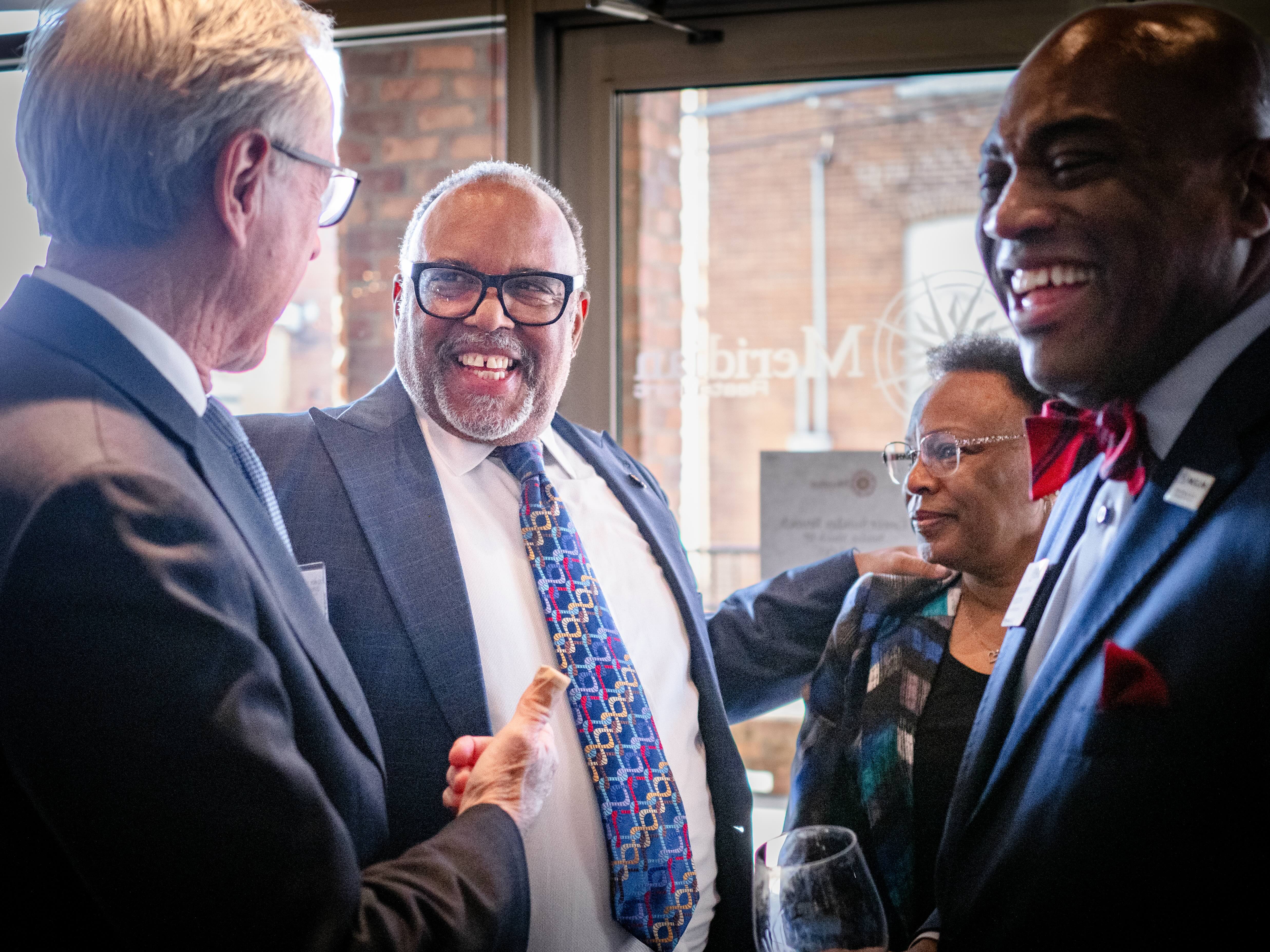
State lawmakers bring myriad background stories that link to or inform aspects of their elected roles. For Democratic Senator Paul Lowe, in his fifth term representing Winston-Salem, a long family background of church leadership makes for a strong sense of calling, community and conversation. The longtime pastor of Shiloh Baptist Church arrived in the Senate in 2015 (initially appointed to fill out an open seat) and has kept focus on community strength through economic and jobs improvements among other approaches. Sen. Lowe has long been active with the League, as well as a dedicated attendee of relevant events, such as our Town & State Dinner series, which legislators and municipal leaders attend together for fellowship and furthering of good working relationships. Southern City caught up with Sen. Lowe recently to learn more about his views on public service and community from the state level.
BROWN: Your history is in church leadership, as a pastor. Did that kind of public service and sense of community lead into or inform your broader leadership as a legislator?
LOWE: I see as an extension of what I was doing as pastor all along. Some people say, “Oh, you're a politician now.” Okay. I think that what you do, as an extension, you're still doing community stuff; you're still dealing with community issues. Every issue we deal with here, it goes back to your district. So that's a community issue. Everything you deal with is a community issue. Something that's going to affect the county, the district, the state – it’s an issue of the community. And that's how I see it. Once you get here, you see how partisan it can be. My goal has always been to try to see how I can look at the middle and say, “Okay, how does that figure out into this?” I think everybody wants to ultimately get to the same place. And it's just, “How are we going to get there?” And what I look at is, okay, Democrats can't give all the money away, and Republicans can't defund the government. We got to find a middle ground to what we're going to do. And how does it affect folks, you know? How do you know? How does it affect the least of these? So we're always looking at that balancing act. That's kind of where I come in. And sometimes your party wants to do something and then sometimes the other party wants to do something else. But how can we get to the middle. That's kind of where I've been and where I continue to be.
BROWN: Why did you decide to get into legislative service?
LOWE: I had done things with the [Democratic] party, worked with the party. So one thing kind of led to another. It wasn't an all-out plan, you know…. But looking at my political approach, I used to call it my three-legged stool, which was education, health and the economy. Those three things. In the economy, we got jobs, got to keep people working. Got to keep them healthy. And then you got to see that they have the education of their children, have the education for the new jobs coming in. I was talking to someone the other day and they were talking about how they just got a degree in computer science -- might be a great degree, might not be with AI. They can do stuff faster than what you used to be able to do with your computer science degree. So is it a good degree now? I don't know, maybe it leads to a high-value gig. Now, I don't know if it's a high-value gig anymore. And that young person – you know, a parent wants them to talk to me, and I'll be glad to talk, but I don't know what to tell them. But if you’re one of those people that really knows how to make the best use of AI, you might be very valuable to somebody. So, how do we reinvent ourselves?
BROWN: Coming from the kind of community background that you have, and now at the legislative level, how do you stay connected to your communities?
LOWE: You have to work at it. I still serve the church, so that helps you to stay connected. That helps a lot. Sometimes it's enough, sometimes not. But it helps a lot. Municipal government, those that work in it, you're right there at ground zero with the people there. Sometimes you're looking at a 10,000-foot level at how all these things come together. And you're looking at what can I do to impact? To help? I usually try to look at municipal government, what they say they want, and try to see what I can do to be the conduit to that as it relates to legislation. I don't really try to get into, “Well we’re the state and we can tell you what to do.” I don't try to get into that. I’ll ask a fire chief. “What are some of the things that keep you up at night and what are some of the big needs?” And I find out the big need is another ladder truck to fight fires. He’s the expert. If he says this is what we need, then I'm going to try to see what I can do to help that. I'm going to see what I can do to help. Period. And I see that as the role. I try to talk to everybody. I think that you can't do this job effectively if you don't really like people -- and that's all the people. The people that agree with you. The people that don't. I'll talk to whomever advocates, lobbyists or whatever. I just kind of have an open-door policy.
BROWN: Is there a style or method of communication you prefer when it comes to talking issues and staying apprised with your local governments? There’s the basic legislative agenda one might hand you, and then there are the continuing conversations and follow-up meetings and so on…
LOWE: I think you have to be open because when you're doing this, you get all kinds of stuff. You have to kind of just kind of be open. Just be open. For whatever. If you're here, you might have to wait a minute, but I'm going to see you. And that's how I try to deal with things. And I think that most of this stuff grows out of relationships. And because you have relationships, you might be able to get closer to getting something done, where, if you don't have any relationships, it makes it a lot harder…. And there's community stuff, things that make for a better quality of life. I think that if you include the arts, that makes for a better quality of life, you know? Now, how much of it can we afford to do? That's another question, right? But it makes for a better quality of life. And I think those are things that we look at.
BROWN: When you think of your district and the communities within it, what comes to mind?
LOWE: Well, the way my district has been cut up (with redistricting), now my entire district is in the city of Winston-Salem, where at one time, I had part of Clemmons, and I had Lewisville. I had Rural Hall. Which I thought it was better. I liked that because it was more diverse when I had those areas in it, whereas when you’re all in the city, urban, you face a different kind of concern. I've got 90% of my district is in the city of Winston-Salem. So that brings with it its own dynamics, challenges, et cetera, because the people in the inner city, they want something and then the people that are closer to the suburbs, they want something very different in many cases. You have to look at, “How am I going to deal with this? What's the best way to look at it?” You know, look at what everybody wants. And now in a lot of our cities, particularly urban areas, they're trying to figure out what to do with young people, because they're very different. Merchants in many cases have to deal with them so differently. Schools. How do you deal with that? People have choices now where they didn't have choices before…. Right now, you got charter schools and private schools, and then people want choices for their tax money. “Well, I'm not using the traditional public schools, so I want my money to go somewhere else.” That's a real new challenge, so that brings another dynamic…. So you got all kinds of new challenges that are beginning to happen. And some of them we’re prepared for, some of them we’re not. I'm even listening to legislation about how to handle certain kinds of things as it relates to social media. The technology is changing faster than we can create laws to deal with it. So those are all things that we’re dealing with now. And I’ll ask people, “What do you want?” Sometimes they don't know what they want, but they know what they don't want, right? And then what has been interesting is local policy, when it makes its way to the General Assembly. What’s interesting is, at the local level, it may not be down partisan lines, but when it gets here, it may be very much down partisan lines. I remember Dare County, they created an ordinance for what do with plastic bags. They wanted it. Most of their people are Republicans. This is what they were doing. Because for beaches, that's a problem. Well, it got caught up in the party apparatus, and the party wasn't having it. Very interesting. And nobody wants a data center, right? But nobody's willing to put aside their cell phone…. It really doesn't mean many jobs at all…. And the people that do the data centers, depending on how the contract is pulled together, they can decide, “We need to be somewhere else.” So then, all of a sudden, you got a pink elephant in your living room. What do you do with it? Then you got the federal issues, which is just … volatile. What’s coming out of Washington now is just volatile. Makes it hard for states to function, and cities. Because you don't know what's going to happen, right? What are you going to do? What’s going to happen? … And we’ve got to figure out what we can do with affordable housing. The only way to fix it is to build. And you've got to figure out what regulations can we tweak to make it easier to build. I'm not sure that cities need to be in the building, but I do think cities ought to deal with certain kinds of financial products. First-time homebuyers, stuff like that. Just my own personal wrangling, because I don't think cities do well and want to build it. And I think there's entities like Habitat for Humanity that do a great job. But when cities get into building and then cities want to socialize homeownership, well, you know, when they get ready to sell it -- you know, the market rate is the market rate. So I don’t know. Those are things I think we’ve got to figure out. I don't know what the best way to figure it out is, but we've got to figure it out.
BROWN: Do you ever get to unplug and sit back and take a break? What do you enjoy outside of work?
LOWE: Music, golf, hunting and fishing…. And I like the arts. I try to really support the arts all I can. Because I think music and the arts heighten the quality of life. It takes it back to community and connecting and inspiration. And so I think you learn a lot from the from the arts.

About the author
Ben Brown
Communications & Multimedia Strategist
Supports the League’s communication strategies as the in-house multimedia producer dedicated to improving awareness of membership services, advocacy campaigns, and organizational goals.
