

City Managers on Philosophies, Qualities & Rewards of the Role
Q3 2026 | Vol. 76, Issue 3
Ask city managers and town administrators about the payoff of their long-hour, specialized and generally high-stakes line of work, and they’re likely to cite the success and happiness of the community around them and the connections they feel to it all.
That was roundly the case when Southern City reached out to different city managers from around North Carolina recently to learn their take on the job and how it’s done effectively.
“When you see projects or programs put into place and hear well-wishes and great comments from the citizens, that’s a great feeling,” said Lloyd Payne, the city manager of Concord. “When you attend the ribbon cutting at that new park and you see the public come out and you see the kids on the swing sets and the folks utilizing the ballparks or whatever the case may be, it’s just a sense of accomplishment, that I had a part to play in this.”
“I recognize that, in my role in this organization, I have the ability to impact a lot of lives,” said Adam Mitchell, town manager of Fuquay- Varina. “I know that when I come to work each day, the goal is to help make the lives of the citizens in our community better every day.”
“I really felt like it was a place where you could make a difference in your community,” said Tasha Logan Ford, city manager of High Point, when asked what interested her in the career to start with. “The way local government touches so many different parts of individuals’ lives drew me to this work and continues to inspire me.”
That’s the note to start and end with in the conversation surrounding the city’s manager role. But there’s a lot in between—the skillsets, the balance of a hundred subjects, the changes over time, the commitment to staff and the elected board.
“I really think it’s a jack of all trades. You’ve got staff that work for you who are the technical experts and the subject matter experts ... but then, as the manager, you’ve got to figure out how to put all the puzzle pieces together to accomplish the goals that your city council has put forward,” said Payne, who has managed Concord since 2018 and has more than 25 years of experience with the role overall.
But what makes for a good city manager?
“I think it’s someone who has to be a critical thinker,” said Ford, who started her local government career in the late 1990s, began working in the city management realm in 2005 and became manager of High Point in 2021, the first woman in the role there. “You have to value and understand the importance of building long-term relationships. A good city manager can bring clarity to complex, abstract issues by providing information and be patient as the elected body seeks to build consensus. And, at times, you have to be able to deliver the tough messages of what is feasible while still encouraging progress towards what is possible.”
Mitchell said he’s made clear, steady communication with elected officials an instrument for that.
“I cannot think of any mayor that I’ve worked with in my career that I did not have a conversation with daily,” said Mitchell, who has been with Fuquay-Varina for 12 years but has around 25 years of municipal management experience. He said good conversation—even if it’s just a check-in—creates the right bond for more important discussions.
“I’ve never really lost the understanding that I work at the pleasure of the board,” Mitchell said. “And it’s my responsibility to help facilitate, help guide them in finding some common ground with each other and commonality on where they want to steer the ship, and help them to develop a strategic plan for how to do that.”
Because managers serve at the pleasure of the board, and because boards are composed of different individuals elected from the community, it’s productive for managers and councils to develop mutual understandings. Duck Town Manager Drew Havens said he’s seen benefit in “candidate orientation sessions,” in which the town reaches out to the candidates who’ve filed for council seats and coordinates an ahead-of-time discussion of how the local government works, the authorities that different roles have, policies and procedures, and so on. The manager and department heads attend to introduce themselves to the candidates and talk about the work they do, Havens said.
“It’s worked really well to eliminate any preconception,” said Havens, who has roughly 25 years of municipal management experience and served in law enforcement prior. He said the candidate orientation session has been the practice in towns he’s worked for previously too. While the manager role supports the vision of the council, there’s stake with local public as well.
“The public wants to know the person sitting in that manager role is giving to the community,” said ] Ford. “They want to see us serving with different community organizations, interacting with our kids at school, exposing the community to new economic development opportunities. We do that by being present. And it isn’t just symbolic. Being present gives you the opportunity to understand the pulse of the community in different ways. It helps you have more information, so you’re more informed and you have context as you’re making decisions.”
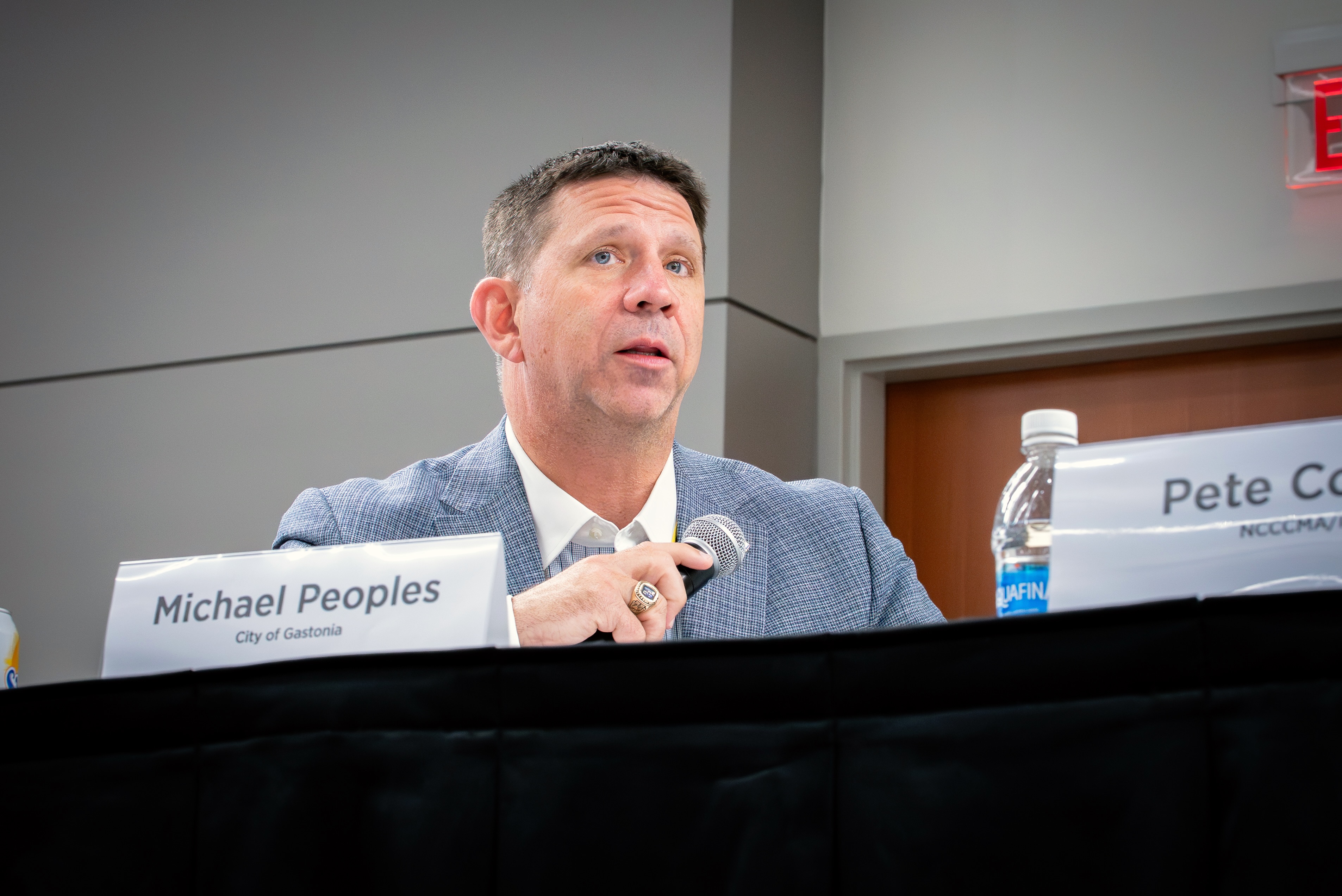
That’s something the manager and council can share, said Gastonia City Manager Michael Peoples: “They see that you’re committed to that and you’re part of this thing and you’re in it together.”
It can create the environment in city hall for pride in mutual goals and achievement. Managers that Southern City interviewed here discussed that with heavy praise for the municipal staffers that make it all possible.
“The big thing for me is the manager might have the big chair, the big office and the big title, but you
as a manager just need to decide that you’re not a big deal,” Havens said. “I can do very little without an effective team of people. I could sit back and take credit for everything that happens in Duck—very little is what I’ve done. I work with the board, get the budget in place, and then my philosophy has always been that you always hire good people, give them the resources they need to do their work, and then you get out of their way. And for 25 years it’s worked exceptionally well.”
While state statute enumerates the functions of a city manager in North Carolina, the varying contexts of the hundreds of cities, towns and villages across the state interact differently with the change time brings, whether it’s in population growth, cultural shifts, technological advancements, job trends, changes in law, or unforeseeables. They can impact how the job is done. “I’ve seen the job change even just over the course of my career,” said Ford.
Generative AI is a big one, even as the world is still trying to understand it. Payne said Concord has used AI in a limited sense for a while, “But now, as we get into this more AI-advanced world, what does that look like for local governments? And I think there are some that are embracing it wholeheartedly and moving forward, while others are being a little more cautious, and I think that’s just really indicative of local government in general. We want to be more efficient. We want to be more effective. But in local government we don’t have the luxury of taking extraordinary risks with taxpayer dollars. … I think there is some optimistic caution with the use of AI. What does it look like moving forward? How do we integrate that into our operations? There’s a lot of different aspects with that that are going to change with how local government works in the future.”
Mitchell noted another 21st century tech revolution.
“There was no social media when I started my career, or at least it was in its very infant stage,” he said, underlining its impact on how the public communicates and reacts, which can affect how a local government approaches conversations and projects.
That has its positives and challenges, he said, but digital technologies over time in general have helped dramatically with efficiency; he recalled finance work being done on a green paper ledger at his first government job and internet access via dial-up connection. “It has made it such that we are able to do more with less in a more efficient and effective manner,” said Mitchell. “Things have just changed, but you find a way to change with them and learn and adapt.”
But even some fundamentals have shifted.
“I think that initially we spent a lot of time talking about infrastructure—there were these hard and fast things that we were dealing with as we were building cities,” Ford said in tracing her career. “The roads, the lights, picking up trash, public safety, the sewer systems, the water systems, and in some communities the electric systems. Those core services people use every day. Over time, I’ve seen investment shift to include more around the quality-of-life kind of amenities that create that sense of place for communities, a sense of belonging—what was that unique thing you needed in your community to draw people there and make them want to stay and want to invest? Today, it’s no longer infrastructure or quality of life; our communities expect both. Now we’re in a phase, based on the age of some of our communities, where we’re again having to reinvest in some of those larger infrastructure projects that really sustain our way of life, but people are also looking for openness, grounding connections and integrating services, and that balance is the heart of modern city management.”

About the author
Ben Brown
Communications & Multimedia Strategist
Supports the League’s communication strategies as the in-house multimedia producer dedicated to improving awareness of membership services, advocacy campaigns, and organizational goals.
